Thursday, August 21, 2008

Lux-urious

I never thought I’d say this, but I think Luxembourg is the most overlooked state in the European Union. It doesn’t have the water or canals like Venice or Amsterdam; and there are no famous beaches. It doesn’t have the fame of Paris, London or Berlin. It doesn’t have the history of Rome or Athens. And although it is home to EU institutions—Eurostat (the national statistic agency), the European Investment Bank (a kindler, gentler World Bank) and the European Court of Justice—it’s Brussels that gets all the EU glory. So where does that leave Luxembourg? In obscurity, exactly where it wants to be.

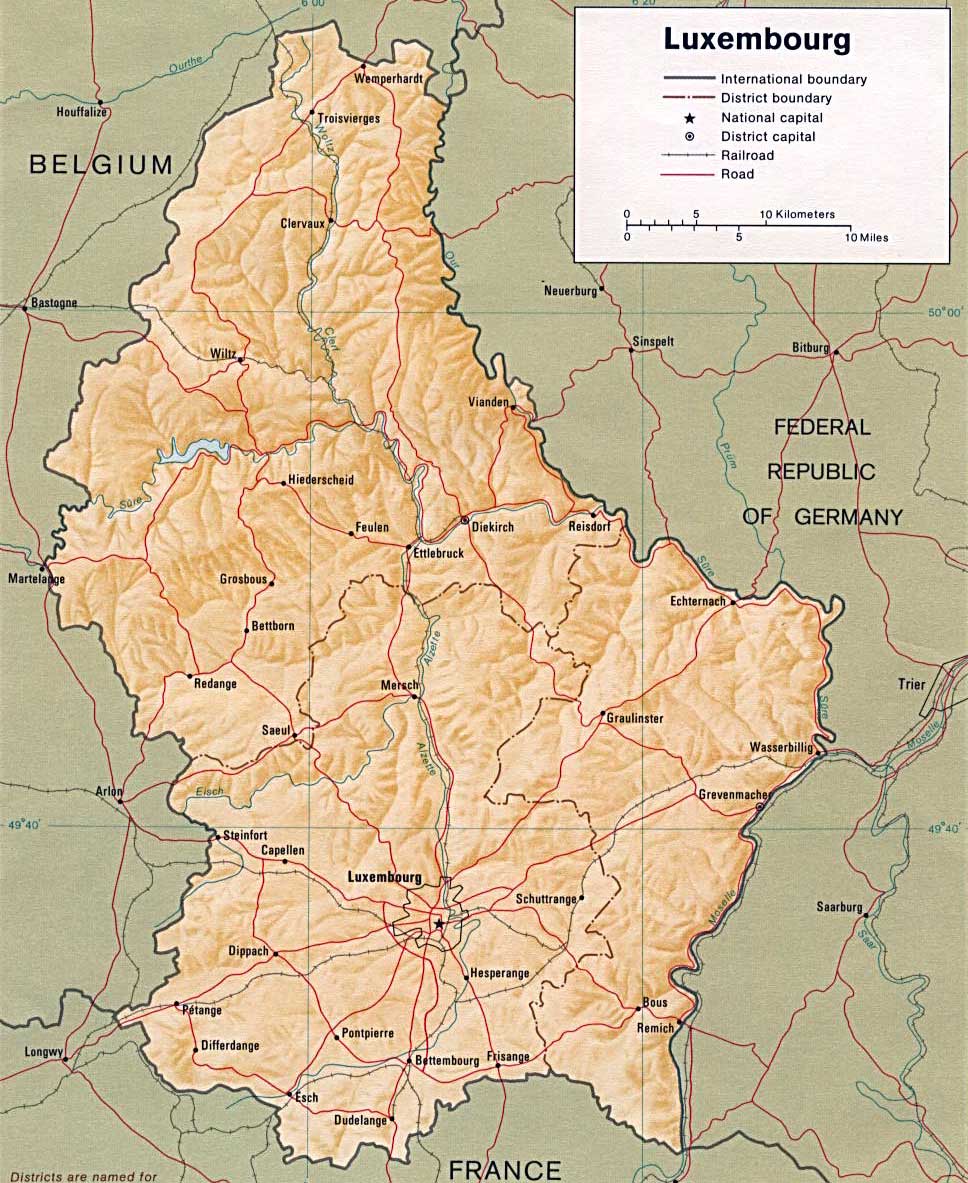
Luxembourg is small in many ways. Slightly smaller than the state of Rhode Island, it is nestled between Belgium and Germany and on top of France. It has a population of about 450,000 who speak three languages: French, German and Luxembourgish which is a hybrid of the two. But it is incredibly wealthy, and has the highest GDP per capita in the EU—which may be a circumstance of its small population more than anything else, but we’ll give Luxembourgers the benefit of the doubt. As a result, there is a strong small-town feel to the city.

For one, it is very clean. Not that Brussels is a dirty crap-hole, but I am no longer surprised to see dog poop (fresh or already trampled-on), empty Jupiler beer cans or still-smoking cigarette butts on the sidewalk. But the streets of Luxembourg looked like they’ve been scrubbed clean that day. They were Toronto-style clean. And there were no homeless people anywhere. I visited Cassandra for an entire weekend and I didn’t see anyone looking less than European chic.

Luxembourg doesn’t feel like a capital city either. It feels like a small town. Most things you need are within walking distance. It's surrounded by greenery. Trees, bushes, ornate gardens are everywhere. And there isn’t the noise of the city. There’s no hustle and bustle, there’s no horns honking or the ever-present police sirens we get in Brussels. Instead there is simply quite. Or birds chirping. I felt more like I was at a cottage in Muskoka than a European city the entire weekend.
And what a blissful weekend it was. Cassandra and her mother and sister had just returned from a cruise along the North Sea that weekend. So on Friday night we drank champagne on her terrace and talked about the trip. The next morning, after sleeping in one of the most comfortable beds I’ve ever lain in and showering in a bathroom the size of my apartment here in Brussels, we had a delicious breakfast of bacon and eggs (which may have been a special treat as Cassandra is well versed of my weakness for pork products). Then we headed off to Germany for the afternoon.

The view from Cassandra's apartment

Sunday was spent exploring the city. I was a little skeptical that we could fit the whole city in an afternoon (we didn’t get going until around 11am thanks to another great breakfast). But we did. First stop was the casemates which are visible from Cassandra’s balcony. Luxembourg has a history of being shuffled from one European power to the other (Germany, France, the Netherlands and even Belgium have laid claim to this little territory), so the casemates, like a fort, were built to protect the citizens. There we saw canons and canon holes and walked among the halls that real soldiers lived in.

Me with the Bock Casements behind me

Where the cannon goesView from the Casemates


Then we walked down by the river and up through a gorgeously old monastery whose giant square hosts music festivals and religious parades.


The Monastary and its square.

Casemates and gardens from beside the Monastary

After lunch we roamed the city centre. Cassandra took me to the Royal Palace. Now I'm no expert on castles, but this one was underwelming. Luxembourg is only a Duchy (meaning its head of state is a Duke) so the castle was not among the most stunning I’ve ever seen. The national bank has much nicer buildings. I’m assured that the Duke has another, more fantastic castle in the countryside.

The Royal Palace


She pointed out the Notre Dame Cathedral, the biggest in the city.

A highlight of Notre Dame was the beautifully intricate carmvings

Somehow we ended up on a tour of weird Luxembourgish statues:


Then there was the giant liberty-style statue commemorating the Second World War.


Finally, we ended at the Pont Adolphe. This was the famous bridge immortalized in a Mini Europe exhibition (and Luxembourg’s only contribution to the park). Its relevance lies in that it is the first bridge made of natural stone built with such an extensive Roman arch (84 m).

By then, we’d seen everything Luxembourg had to offer. In all honesty, I’d never thought of visiting this tiny country. But I can see why Cassandra and her family chose to live here.

Tuesday, August 19, 2008

For the Ottawans.

For all of you reading this who live, lived, have visited or spent time in our nation’s capital, this post is for you. While sitting in a train station in Cologne waiting for my train to arrive I looked up and was met with this beautiful sight.


And for a second I was transported to the O-Train platform at Greenboro or Carleton. There are no bells (or bilingual British woman voice) in the German version. But it was enough to make me nostalgic for the countless times I spent running to catch it.

Monday, August 18, 2008

Living Life in First Class

Aside from the great cities, beautiful landscape and interesting sights, another reason my trip to Cologne and Bonn was so great had to do with the fact that I traveled first class. No, I haven’t suddenly come into a great deal of money (I wish). I’m just a canny planner—and a little bit lucky. When I booked the train to Cologne I was able to get a ticket in first class for cheaper than it would have cost to go in second class. So it was a no brainer.

I’d never gone anywhere first class before and I had no idea what to expect, except that there was going to be a meal because it said so when I booked. We caught the 10:30am train to Cologne, so our “meal” consisted of drinks and a snack. I chose a lemony tart and a Coke (I need my morning shot of caffeine). Based on this, riding in first class was less than spectacular. But the side benefits were pleasant. I grabbed a complimentary copy of the Financial Times, and cozied up in my single chair (with ample leg room) near the window, put in my iPod earphones and away we went. But it wasn’t all Champagne and mints-on-my-pillows. While I had taken advantage of the promotion, so had about three other families and their young, noise-making children. They caused a bit of a commotion for a substantial portion of the three and half hour train ride and put a damper on my first class experience.

But the ride back more than made up for it. For one, there were a lot less people. In the entire car, I could see about four other people, so it was a substantially quieter ride. And what people there were had the distinct aura of business people. There was one Brit and a young woman who looked like she was ready for a business meeting, complete with pencil skirt and stiletto heels (keep in mind this was a Sunday night). People looked at me in my jeans and ballet flats as if I was riffraff.

Secondly, the meal this time around was substantially better than Saturday’s breakfast.

It came with the following: a piece of salmon with lime; a slice of pineapple in the shape of a star (no joke); 2 swigs of lettuces and a slice of shaved cucumber topped with phenomenal dressing, all served atop a sprinkling of two kinds of nuts (which I was less than enthused about but knew my mother would approve of); also provided were butter and cheese that—I’m sure—were both highly subsidized by the EU’s Common Agricultural Policy to adorn the unlimited bread and drinks we were offered. Always one to make the most of situation, I helped myself to two servings of rolls and drinks. But the piece de resistance was truly the desert called “Delight” which was not a delight but definitely hit the spot. And on top of this, I knew I was in good company when I was given real utensils (a fork, a knife that actually cut things, 2 spoons (why one wouldn’t do I’ll never know) and a toothpick) and a linen napkin (no plastic in sight).

I'm sure for the males in the car--whose appetites can be quite large--the portions where quite small, but they were just right for me. Needless to say, I was impressed.

Friday, August 15, 2008

What's in a Name?

For those of you who read this blog and type the address into your browser consistently, you’re probably wondering what it means. Euro Grand Tour? I’ll give you a hint. I’m a history buff, so it’s always a safe bet to start there. This gives a pretty good explanation of where I got them name.

I’m not saying I’m some British noble –in lineage or bank account—but that was my inspiration.

Shake Your Bonn Bonn

The next morning, Matt and I split ways. He went on to Romania (Bucharest to be more specific) and I carried on to Bonn, a 20 minute train ride south of Colgone. Although I left plenty earlier (10am), I didn’t arrive in Bonn until 12:30pm thanks to a horrible experience where I took the wrong train and nearly ended up in Koblenz. But, once I was in Bonn, I found it was worth the trouble.
Bonn is a small city but its major significance is that it was the capital of Western Germany during the Cold War. It was also the birthplace of Beethoven, the composer. That alone was enough to sell me on the city, but it’s much more than a historical relic. It’s just a very beautiful city.
Bonn is divided into two areas: the older, prettier center of town and the newer area near the river dominated by old West German government buildings. I started here and decided to work my way back up to the center of town. The woman at the tourist office had sent me via the boardwalk so I had a lovely walk through the city square and then along the Rhine river.


The buildings that make up the government area are not pretty. They’re squat 1960s-style industrial buildings with brown roofs and dull metal paneling. The best example of this is the old Bundesrat, the building where West German politicians met. It was torn down and a new Bundestag was built. It was this new Bundestag that I wanted to see. It was one of two things I insisted on seeing while in Bonn (the other was a visit to Beethoven’s house), and I had already decided I was going to take a tour. My plan encountered a slight hiccup when I went in at 2pm, looking for a tour and found they were only available in German…Well, I’d walked all the way down here and it was on my list, so I was going to do it. And I did. I spent an hour listening to a German man explaining the architectural and historical significance of the building without understanding a single word. Fortunately, there was a young woman who spoke phenomenal English and somehow divined that I didn’t speak German (maybe it was my blank stare?). So she translated for me. So most of my information comes from her.

Construction on the Bundestag began in 1988, under the guidance of architect Günter Behnisch. Given that it was built in the thick of the Cold War, democracy was an important principle in Germany. Therefore, democracy and transparency in government is a consistent theme throughout the building. In fact, it was (at the time) the world’s only transparent parliament, as the building is made mostly of glass.


The lobby is a wide open space with only two doors: one to the outside (which is made of glass) and the other to the parliamentary chamber (also made of glass). As a result of all the glass, it’s very bright and there is green foliage all around given the feeling that nature is coming inside. This is to symbolize that democracy is a natural phenomenon. A (coloured glass) partition separates the press from the politicians, but no doors, symbolizing that West Germany’s politicians should always be, at least accessible, to the press. The lines on the floor lead to doors, and depending on which one a politician stands at, indicate whether he is ready to speak with the press.


Another theme of the building is the concept that democracy and government is a task that is unfinished. As a result, the painting on the poles framing the (glass) elevator is painted yellow except for the very top where the architect purposely stopped in order to reinforce this theme.

The theme of transparency is carried inside the chambers as well. The walls of glass and the ceilings are exposed and with out covering, so you can see the lights and ceiling tiles.

This parliament was never used by West Germans as reunification happened before construction finished. It was used from 1992 to 1999 as the seat of German government, but after that government operations moved to Berlin. Today Bonn still holds some ministries and secondary residences of the Chancellor. The building is currently being used as a conference centre. Also in the neighborhood is a UN building. I find it interesting that it happened to be located in the heart of West German government…

As I was walking back to town I somehow ended up on the Path of Democracy. Some of the sights were pretty cool (the Chancellor’s residence, the first place the West German Parliament convened was in a converted waterworks building), but some were lame (the old Foreign Affairs ministry, a science museum). Here are the pictorial highlights. Read along with the website.


That sexy beast is one-time West German Chancellor Kondrad Adenauer.


Then I walked through the center. Like most capitals, Bonn seemed like it was cleaned up for tourists. The banana colored university building seemed to sparkle in the sunlight and the pink paint of City Hall was gleaming.

Then there was the Opera house that you could tell was built during the Cold War.

My last stop was Beethoven’s house, now a museum dedicated to his life. It was a really great museum and I wish I’d had the time to really go through it. There was some really good stuff: the ear trumpets Beethoven used to hear with when he was going deaf, two of his pianos, a violin given to him as a first gift and his first instrument, pages of his work, portraits, and a death mask (true story). What’s interesting about this site is that Beethoven actually hated living in Bonn. He lived there for the first 18 or 20 years of his life before he moved out and then spent the rest of his time in Vienna. But if I were Bonn, and was no longer the seat of German politics I’d stick with Beethoven too. Here are some pictures of the museum and the huge statue they have of the man in Beethoven Square.

Eau de Cologne

Then, after an exhausting week of doing absolutely nothing at work and saying goodbye to fellow intern friends as they fled the country, all while trying to put off moving out of my apartment into my newer (and smaller) one, I jetted off to Germany for the weekend. We spent two days in North Rhine-Westphalia state along the Rhine River and it was quite enjoyable.

The first stop was Cologne (or Köln in German). Three hours from Brussels, Cologne is known for its Gothic Dom (Cathedral), which is the largest in Germany and somehow escaped being blown to smithereens during World War II.

And it’s pretty big; 509 steps from the bottom to the top. And I climbed them all. They tell you it takes about an hour to climb to the top, but yours truly did it in half that. This despite the foul smelling and vertigo-inducing spiral staircase—imagine what a hundred years of people climbing up 509 stairs and sweating in a very confined space with minimal oxygen smells like. In any case, it wasn’t bad. After a certain point we got to the bell tower and there was a gorgeous breeze to cool us off. And had I paid €1, I could have rung the bells Quasimodo-style. But I didn't. But the view itself was worth it. That and the bragging rights. Here are some pictures from the top.

(Me pulling a King Arthur and trying to pull a "sword" out of "rock")

What was also astonishing was the amount of graffiti on the way up. Now I understand that climbing 509 steps is a feat. I did it, I get it. But there’s no reason to deface a two hundred year old Cathedral. And not just any old Cathedral either. The church also houses the Shrine of the Magi which allegedly holds the remains of the Three Kings. So it was especially tragic to see “Sally was here ‘99” in White Out on the top.

The rest of the church is stunning. So gorgeous that someone was actually getting married as we toured it. I can imagine why they would want to get married there. It has absolutely massive stain class windows which I couldn’t resist.

After the church we walked around for a bit. We check out 4711, a store that sells Eau de Cologne, a perfume that two hundred years ago, was believed to be a healing elixir, so people used to drink it. Now they spritz it on them to smell nice. The name, 4711, dates back to Napoleonic times when they used to name streets using numbers.


Then we took a walk along the Rhine River. We walked through an impromptu battle of the brass bands that was happening in front of us and intercepted a German-style Run for the Cure marathon. Never a dull moment in Cologne. We also tried to jump on a Rhine boat tour but they were too expensive.


So after a hunt for a restaurant that didn’t exist, we strolled through the old city until dinner. We had a lovely dinner along the river—which included a class of Kölsch, the local brew—and then waited until the sun set so we could walk across the river and see the Dom at night.


These pictures were the best out of 28 attempts. Anyway, once I was satisfied with the shot, we went back to our hostel for the night.